Substack
Why Is TCS Laying Off So Many Employees?
In Part 2 of the TCS series, we probe how the IT bellwether is the proverbial goose that lays golden eggs for the Tata Group

Sandhya Ravishankar
Substack
Part 1 of this two-part series exposed that TCS had retrenched over 30,000 employees, as against the announced 2% of its workforce or 12,000 employees. The company denied the same.
But the question that many TCS employees are asking is - why the layoffs? What happened that prompted these massive layoffs? Part 2 is an attempt at answering that question.
By the end of this article, the reader will be able to decide for him/herself what went wrong at TCS.
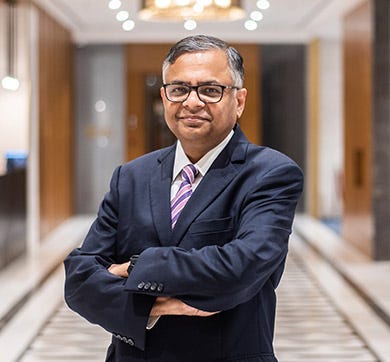
N Chandrasekharan, Chairman, Tata Group; Image courtesy: Tata Group
Restructuring Chaos
Before 2017, TCS was organised by its legendary CEO N Chandrasekharan into Industry Service Units or ISUs - these were sectorwise groups combined with geographical locations of the employees. For instance, a manager who has a client in the auto sector in Bengaluru could simply look for employees under the sector and geography.
In January 2017, then CFO of TCS, Rajesh Gopinath, was named the CEO of the firm.
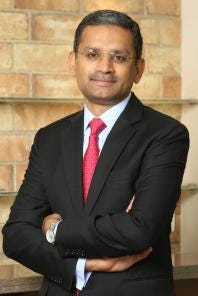
Rajesh Gopinathan, former CEO, TCS; Image courtesy: IIT Bombay
Shortly thereafter, he decided to restructure the firm. Instead of geographical location, the parameters became deal size.
Gopinathan created three new verticals – Relationship Incubation Group (RIG), Enterprise Growth Group (EGG) and Business Transformation Group (BTG). Banking and Financial Services Institutions (BFSI), the largest vertical, was left untouched as it was headed by K Krithivasan, a close protege of N Chandra.
But the rest of TCS’ businesses now had to be sub-divided even further into:
Relationship Incubation Group or RIG: Deal sizes of less than $5 million
Enterprise Growth Group or EGG: Deal sizes of $5 million to $500 million
Business Transformation Group or BTG: Deal sizes of over $500 million
“The creation of these new verticals threw the entire organisational structure into chaos,” said a senior TCS Employee C, who requested anonymity to avoid repercussions at the workplace.
“This was around the time the organisation needed more mid to senior level executives to lead the various units introduced by Rajesh Gopinathan. Covid struck around this time and they needed more people in any case to work on cloud. The hiring spree began around 2019 and continued through Covid,” said Employee C.
With senior management in uproar, N Chandrasekharan was forced to step in – he had since moved to a role in Tata Sons. In March 2023, a visibly relieved Gopinathan stepped down as CEO, something of a shock resignation, as he had four years left as CEO.
“I can’t tell you how happy and light I feel,” he told mediapersons at the press meet.
K Krithivasan was appointed the CEO. Krithi, as he is better known, reversed the structure to Chandra’s original style.
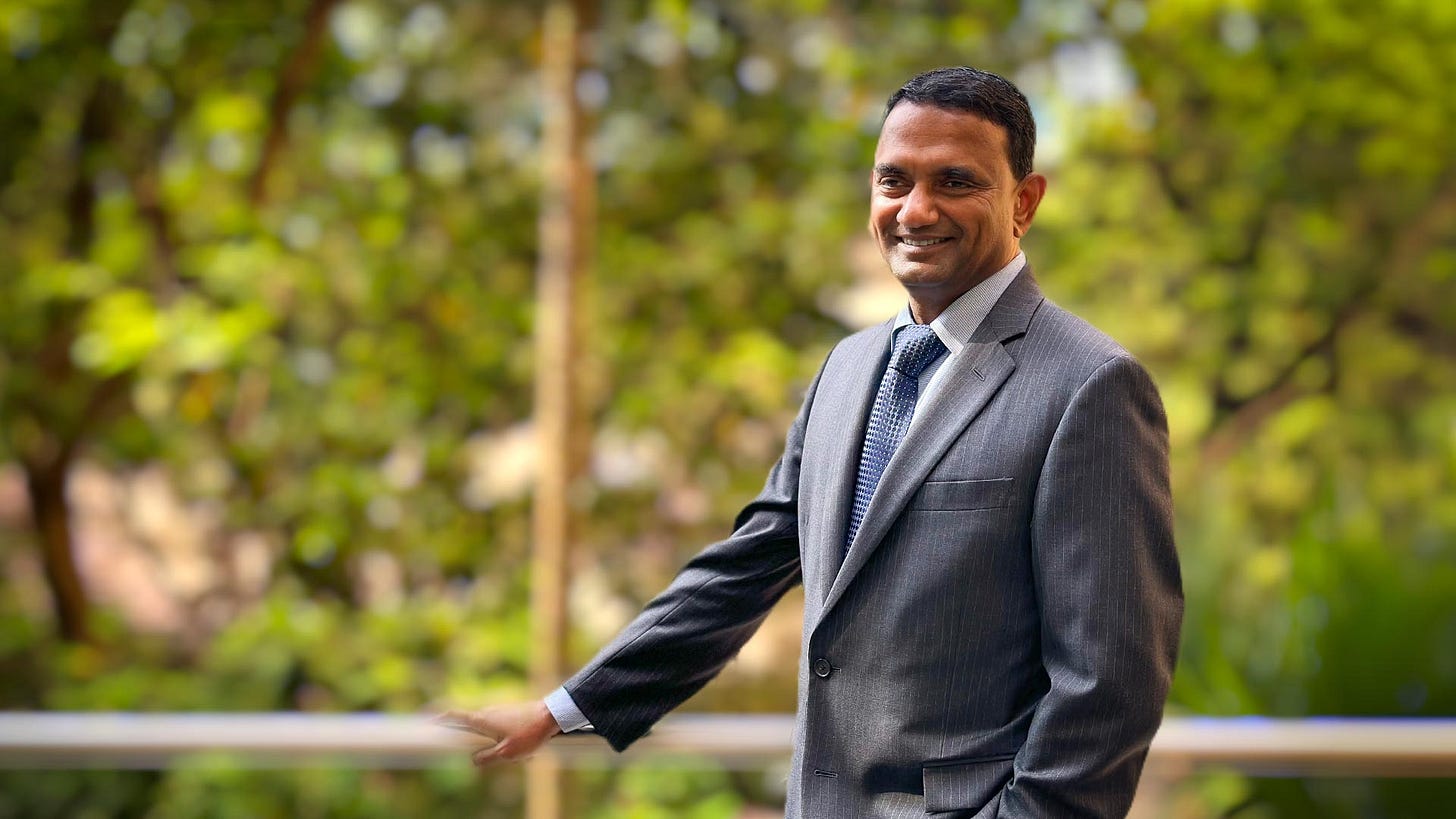
K Krithivasan, CEO, TCS; Image courtesy: Tata Group
But now TCS was heavy with mid and senior level employees.
In October 2024, the maverick Ratan Tata breathed his last. His half brother Noel Tata took over the Tata Group.
Noel Tata, Chairman, Tata Trusts; Image Courtesy: Associated Press
In May this year, Aarthi Subramanian, another N Chandra protege and known to be an efficient leader, took on the role of Chief Operating Officer of TCS. The retrenchment plan was put on fast-track.
Aarthi Subramanian, COO, TCS; Image courtesy: World Economic Forum
“There are a few young hires from prominent B-Schools who have been given the job of collating data on employees and to identify whom and how many should be sacked from each department,” said the highly placed source. “People are being laid off without a fair chance or due process. It’s a numbers-driven process and managers are not given a chance to argue for their employees. They are simply told - give me X number of names from your team who are in the mid to senior category and HR will do the rest. This is why everyone is so shocked. It goes against the grain of everything the Tata Group once stood for,” a highly placed source told this journalist.
With a question mark over their future, TCS employees asked this journalist - why is TCS continually trying to please shareholders rather than take care of its employees? Why conduct layoffs at TCS which brings in the maximum revenue among Tata Group companies? Why are there no layoffs taking place in other Group companies which are loss-making? Why not shut them down?
The Goose That Lays Golden Eggs
This question prompted research into how the Tata Group functions.
As per the latest TCS annual return of March 2025, Tata Sons owns 71.74% of the company.
Tata Sons is the mother organisation, holding the majority stake in all Tata Group companies either directly or indirectly.
In TCS, Tata Sons holds 2,59,54,99,419 shares or 259.5 crore shares. And this is where the nub is.
TCS is, in essence, the cash cow or the proverbial golden goose for the Tata Group. With around 25% margins, the highest by far in the IT sector, it is the highest revenue generator for the group, financing other pet projects of the Tatas - whether they are profitable or loss-making.
Take a look at the data and the pieces fall into place.
An analysis of the dividend paid by TCS to shareholders is revealing. Dividend is a distribution of profits by a company to its shareholders. Companies usually announce dividends for shareholders after a very profitable quarter.
But TCS is not like other companies – it gives dividends every single quarter, sometimes twice a quarter, to its shareholders. And its largest shareholder is its parent – Tata Sons.
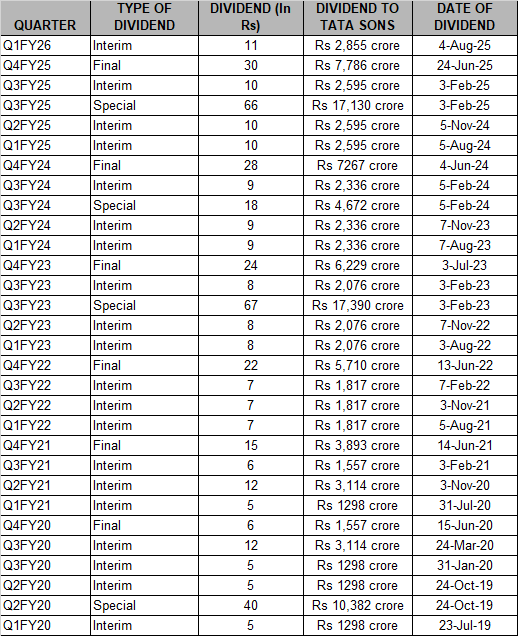
Dividend announced by TCS in each quarter from Q1FY20 to Q1FY26; Source: TCS Annual Returns
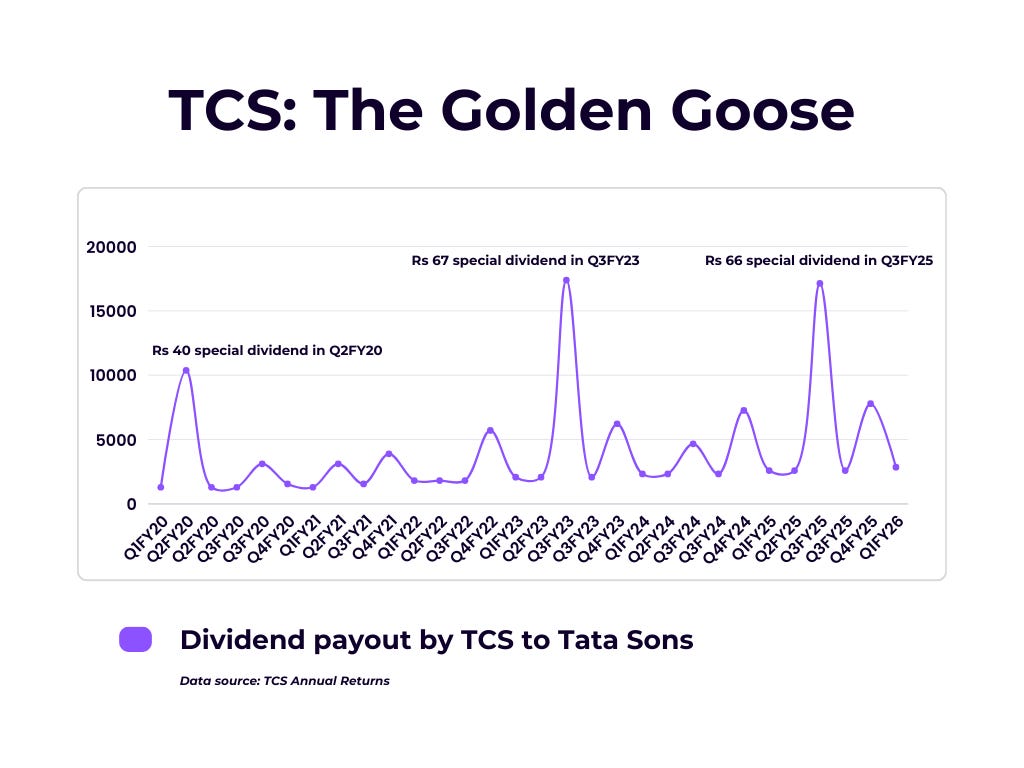
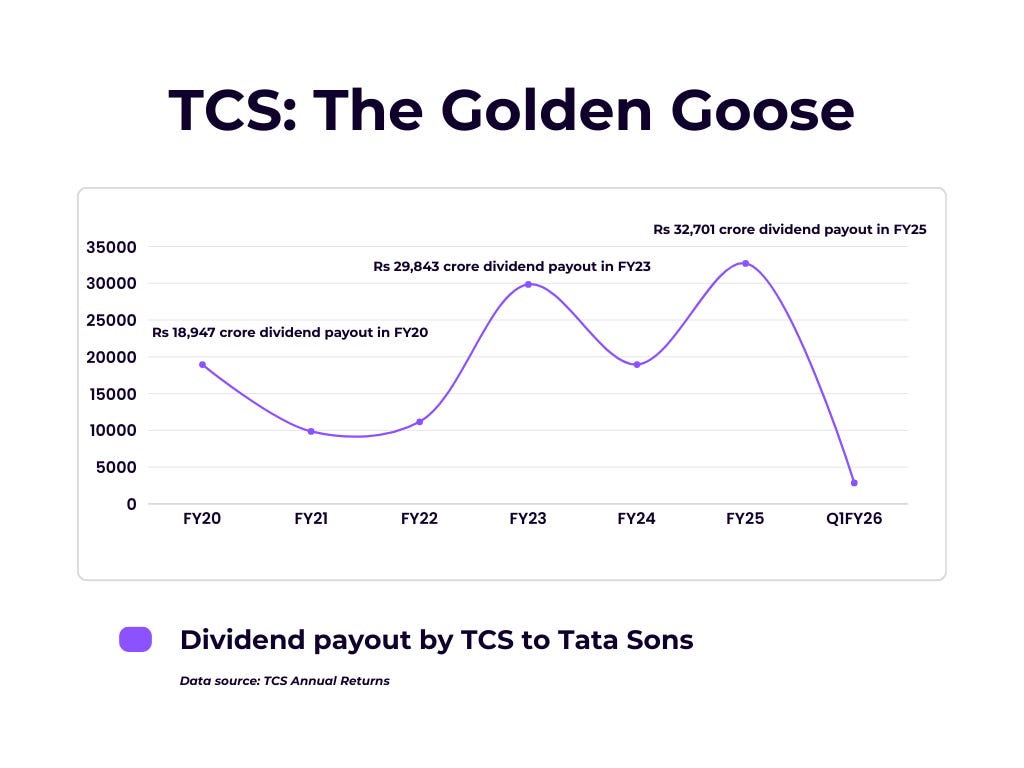
Between FY20 and FY25, Tata Sons has got a whopping Rs 1.21 lakh crore as dividend payout from TCS.
During this period, in 2020, the Tata Group set up Tata Digital, with the aim of creating a “leading omni-channel retailer with a presence in electronics, food and grocery, pharmacy (e-pharmacy, e-diagnostics), fashion, travel & hospitality, financial services and payments.”
Tata Digital acquired 64% stake in Big Basket in 2021 at a cost of Rs 1,591 crore. In May 2022, the company purchased an additional 10% stake in Tata Play (formerly Tata Sky DTH) from Baytree Investments (Mauritius) reportedly for a sum of Rs 835 crore. This was followed by the remaining 29.8% stake in Tata Play owned by Walt Disney, for an undisclosed amount.
Tata Digital has consistently posted losses since inception with the latest FY25 annual return showing a loss of Rs 827.54 crore. Its Tata Neu superapp is a non-starter.
Also in 2020, Tata Electronics was established to manufacture electronics and provide semiconductor assembly and testing, semiconductor foundry and design services. Tata Electronics posted a loss of Rs 997.81 crore in FY25.
Tejas Networks was acquired in 2021, a telecom manufacturer with an end-to-end mobile wireless product portfolio. The company posted a profit of Rs 450.66 crore in FY25 and announced a dividend of Rs 44.08 per share.
In January 2022, Tata Sons went on to acquire a bleeding Air India for Rs 18,000 crore through Talace, a wholly owned subsidiary. Air India and Air India Express together reported a combined loss of Rs 9,568.4 crore in FY25.
Agratas was established in 2023 to design, develop, and manufacture advanced battery cells and energy storage systems. The firm is constructing two battery gigafactories in India and the UK. Agratas has posted a loss of Rs 566.49 crore in FY25.
And so the goose that lays the golden eggs - TCS - must cough up, so that the conglomerate’s passion projects may be kept alive. And if that means laying off employees in the tens of thousands, then so be it.
Note: Tata Group did not respond to an email questionnaire on its restructuring & management practices except to deny that they had laid off 30,000 employees. This journalist reached out to Rajesh Gopinathan, former CEO, TCS, seeking responses to an email questionnaire. No reply has been received from him until the time of publication. If he responds, a separate article will be carried with the same.
*This article was updated on September 18 at 5:48 pm to correct the spelling of Tata Neu which was erroneously written as Tata New.
Originally published on Substack. Open the original.
Read the next one by email
Support this work
A UPI payment, if you would like to.