Substack
Clean Up The Mess In Mines Dept., C.M. Sir
If the TVK government is serious about anti-corruption, their first task should be to look into the Tamil Nadu Geology and Mining Department

Sandhya Ravishankar
Substack
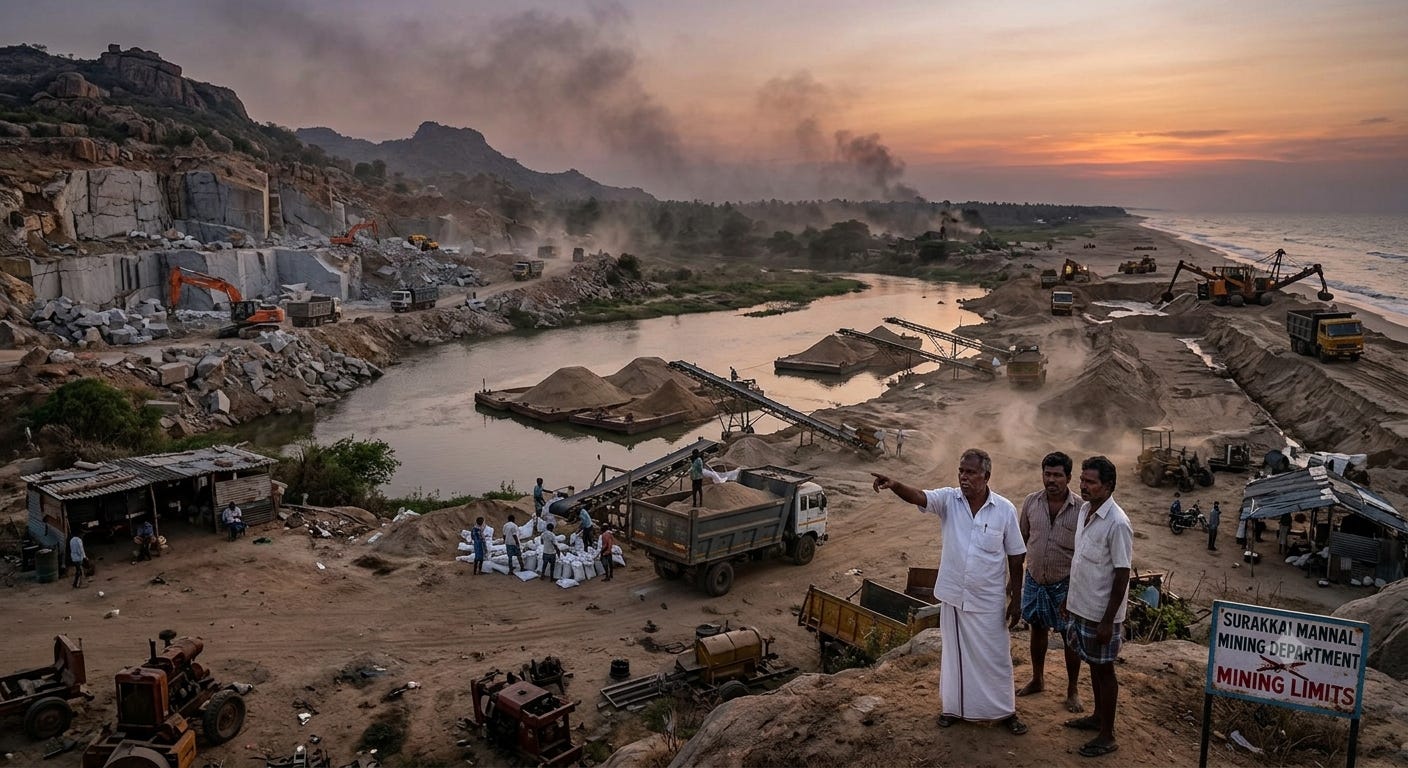
Image generated by AI
Two judgements of the Madurai bench of the Madras High Court have gone unnoticed in the unnecessary theatrics of the Assembly Session and subsequent news developments.
These two judgements speak volumes about the rot in Tamil Nadu’s Department of Geology and Mining.
While the new minister T.K. Prabhu has ordered the temporary closure of 67 quarries for alleged irregularities and levied penalties on 155 more, an enormous overhaul is awaited in his department.
Judgement 1
The first judgement we will look at was delivered by Justice B. Pugalendhi of the Madurai Bench of the Madras High Court on June 03 this year.
The judgement raises a pertinent question about corruption at the highest levels of the Tamil Nadu Geology and Mining Department — specifically the then Commissioner himself.
The case in question was of a miner C. Ramesh who was found to have illegally mined and transported gravel sand and stone. This illegal mining came to light when several people died in an accident at the quarry in Palamadai village, Tirunelveli district in May 2022. A routine departmental inspection unearthed the illicit mining. The department levied the full cost of the illegally mined gravel and stone as well as the seignorage fees on Ramesh — the penalty to be paid was ₹13.7 crore.
Ramesh appealed this penalty with the Commissioner of the Geology and Mining Department that same year.
Shockingly, the then Commissioner, in November 2022, modified the penalty from ₹13.7 crore to just under ₹2 crore. The Commissioner deleted the cost of the illegally mined gravel sand and stone from the penalty.
A month later, the petitioner once again gave a representation to the Commissioner — the penalty was further reduced to ₹1.33 crore.
The Commissioner also extended Ramesh’s lease by five months, “beyond his jurisdiction by usurping the powers of the District Collector / Assistant Director (Geology and Mining),” as recorded in the Court order.
The Government set aside the order of the Commissioner subsequently and levied a higher penalty on the miner, Ramesh.
The Court, however, asked whether the then Commissioner of Geology and Mining had issued similar orders in other cases — the government admitted that he had, in fact, done so and NGO Arappor Iyakkam had also flagged the discrepancies to the government.
The Court observed that the actions of the Commissioner in reducing the penalty as well as extending the mining lease without having the powers to do so was “atrocious, without any jurisdiction and against the law, which cannot survive for even a moment. The manner in which the appeals of the petitioner have been dealt with by the Commissioner raises reasonable suspicion as to whether corrupt practices were adopted by the Commissioner in dealing with the appeal of the petitioner, which requires further investigation.”
The Court also directed the government to review all orders passed by the then Commissioner under Rule 36-D of the Tamil Nadu Minor Mineral Concession Rules, 1959. It is unclear whether this review is underway.
Judgement 2
The second judgement referred to in this article, was also delivered by Justice B. Pugalendhi on the same day, June 03 this year.
The petitioner Ponnudurai, who was an Assistant Executive Engineer in the Tamil Nadu Agriculture Department, had colluded with sand miners and was caught and arrested by the CB-CID. During the Covid pandemic, Ponnudurai had given approvals for construction of farm ponds on non-farm lands between March 2020 and July 2020. The miners had used these approvals to mine sand with abandon while all attention was turned to the lockdown in force.
Some of the charges against Ponnudurai were as follows:
(i) Issuing work orders for the construction of farm ponds not on farm land but on nearby survey numbers which is against the scheme rules.
(ii) Issuing work orders for the construction of farm ponds on plantations and lands owned by private companies which is against the scheme rules.
(iii) Establishing five farm ponds on lands without water sources and causing loss of ₹7 lakh to the government.
In 2022, a departmental enquiry found Ponnudurai guilty of eight charges, including the three above, and he was punished departmentally — no increment for one year and 50% of the losses incurred due to him were to be recovered from his salary. So Ponnudurai got slapped with a fine of ₹3.5 lakh, and this was recovered by deducting ₹25,000 every month from his salary for 14 months.
In the meanwhile, in 2021, the Tirunelveli police registered a case pertaining to Manuvel George who was allegedly misusing the quarrying licence granted to him and indulged in illicit sand theft. Realising that multiple government officials were involved in this case, it was transferred to the CB-CID by a Division Bench of the Madras High Court in Madurai.
Ponnudurai was subsequently suspended and later arrested by the CB-CID. He had approached the Madras High Court asking that his suspension be revoked.
The Court found that Manuvel George, the illicit sand miner, was a resident of Kerala. He, helped by the above mentioned government servants dug up fake farm ponds without permissions and illegally transported M-sand (manufactured sand) to Kerala.
In Ponnudurai’s petition, as well as the CB-CID’s final report, it is found that two other government officials had been in on the illegal sand mining scheme. One is Kalaimuhil, an Assistant Engineer in the Agriculture Department who obtained anticipatory bail and did not suffer even a suspension.
The other is an Assistant Director of Mines, S. Safiya, who was also arrested in the same case and released on bail. She too was suspended but her suspension was revoked in a mere four months. The CB-CID report quoted by the Court found that her husband Sayed Sameer had been acting as a broker at the Geology and Mining Department in Tirunelveli and got his wife to issue permits, in violation of the laws.
The Court also questioned the Tamil Nadu government’s wisdom in revoking suspension of Safiya who had caused a loss of ₹9.6 crore to the State exchequer by failing to inspect quarries and issuing transport passes to illegally mined sand and gravel.
Safiya continues to serve as Assistant Director, Geology and Mining in Kanchipuram.
The Court came down heavily on the government for not punishing errant officials such as Safiya.
“Such slackness in initiating disciplinary proceedings and taking action against the erring officials would only embolden the other officials to indulge in such activities. The reputation of the department depends on the integrity of its officers and even one drop of poison would spoil an entire tank of water,” reads the Court’s order.
Unless errant government officials face the full force of the law, corruption cannot be rooted out of the existing system. The people’s mandate has been for the TVK and Vijay, in particular. If he wishes to roll out the corruption-free administration he has promised, Chief Minister Vijay would have to ensure heads roll in government departments. And the Geology and Mining Department is the best place to start.
Originally published on Substack. Open the original.
Read the next one by email
Support this work
A UPI payment, if you would like to.