Substack
Want to Stop Illegal Mining? Regularise & Legalise It, Says TN Govt
The Tamil Nadu government adopted an objectionable recommendation in the Allaudin report but the Court thankfully put a stop to it

Sandhya Ravishankar
Substack
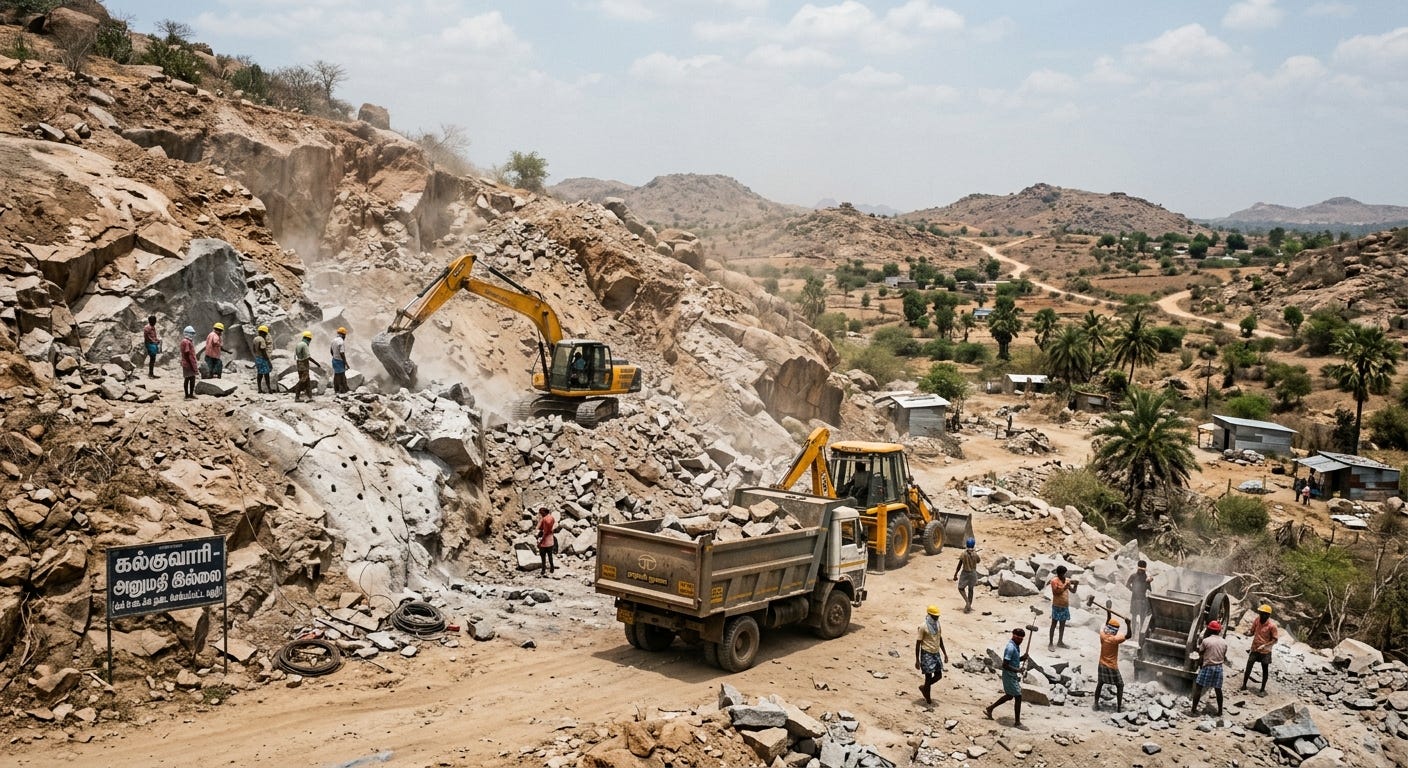
AI generated image
A Government Order (G.O.) dated January 22, 2026, issued by the Natural Resources Department of Tamil Nadu directed the implementation of a legally untenable recommendation by the K. Allaudin IAS-led Committee that probed illegal quarrying in the State.
The then Director of Geology and Mining, D. Mohan, sent a proposal to the State government for One-Time Regularisation (OTR) scheme “to levy penalty for excess quarrying in leasehold area on the defaulting lessees.” This proposal was approved by Shunchonngam Jatak Chiru, who was then Additional Chief Secretary to Government (FAC). This regularisation scheme was proposed based on representations made by Stone Quarry, Crusher and Lorry Owners Association.
The cut-off date for the regularisation process was set as April 06, 2015 — meaning this regularisation scheme would be applicable to illegal mining carried out before this date.
This OTR process significantly reduced the penalty to be paid by illegal miners to the State government. Earlier, the penalty for illegal mining was ₹5 lakh per hectare or five years’ imprisonment or both. This G.O. undid all that.
The logic in the G.O. was that it was difficult to arrive at the exact quantum of illegal quarrying and therefore a “weighted average of Seigniorage Fee” of ₹25 per metric tonne would be levied as penalty on the illegal miners.
A seigniorage fee is royalty collected by the government for mining sand and stone.
Seigniorage fees in the state as of May 2025 are as follows:
Rough stones & crushed materials: ₹33 per metric tonne
Ordinary sand: ₹120-160 per cubic metre
Ordinary earth & gravel: ₹56 per cubic metre
Black Granite: ₹5,210 per cubic metre
Coloured Granite: ₹3,133 per cubic metre
Ordinary clay or tile clay: ₹56 per cubic metre
As is evident, the seigniorage fee is a fraction of the actual value of the illegally mined minerals or the existing penalty.
The government also directed that “the excess quarrying operation within leasehold area shall be regularized as a one time measure by collecting two times seigniorage fee as compounding fee to the Government Exchequer.”
The government was kind enough not to charge Mineral Bearing Land Tax too. Tamil Nadu’s Ease of Doing Business for illegal quarry owners is truly commendable.
For those miners who had illegally quarried in areas outside of their leased land, the penalty was five times the seigniorage fee.
The State government was so friendly towards the miners that a quasi-EMI option too was made available to them.
For penalty upto ₹10 crore, the defaulter could pay 20% of the penalty upfront, restart quarry operations and pay the remaining 80% in two equal instalments within a year.
This scheme was valid for two years.
Thankfully, however, the judiciary was more vigilant.
On June 24, the Madurai Bench of the Madras High Court ordered an interim stay on the implementation of the G.O. after an NGO Abdul Kalam Science Farmers filed a case.
A Bench comprising Justice N. Sathish Kumar and Justice M. Jothiraman prima facie found that the G.O. “runs contrary to the very statute” — meaning that the regularisation and the EMI option for penalties went against the provisions of the Mines and Minerals (Development and Regulation) Act.
The Allaudin report itself has not been made public. The people of Tamil Nadu have no idea what this Committee found in terms of illegal mining of natural resources and who these miners are.
The new government under Chief Minister Vijay must make the report public and ensure that the One-Time Regularisation scheme is scrapped. Illegal miners must be made to face the full force of the law.
Originally published on Substack. Open the original.
Read the next one by email
Support this work
A UPI payment, if you would like to.